
Workforce Snapshot and Hiring Demands Analysis of the IT Employment Rate in Vietnam for 2026
As 2026 approaches, the employment rate in Vietnam in the technology industry reflects the country's strong growth and structural maturity. Driven by a youthful, hungry, and highly specialized workforce, Vietnam's IT labor market is durable despite volatility in the global economy. "What is the quality of that talent?" and "where does it fit in the value chain?" are becoming more important questions for multinational corporations than just "is there talent available?" A detailed look at the 600,000+ workers driving this digital revolution is available in JT1's Vietnam IT Salary Guide 2026.
1. The Workforce Scale and the IT Employment Rate in Vietnam
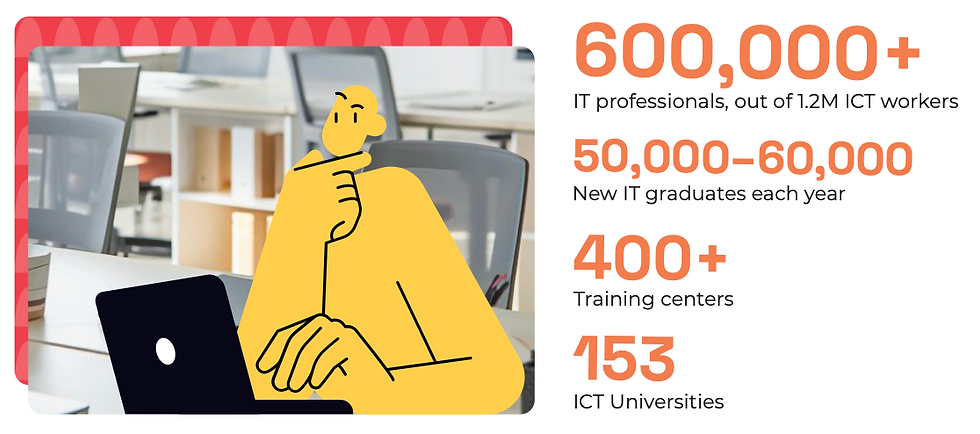
The sheer amount of skill is a crucial consideration when examining Vietnam's employment rate in the IT sector. With more than 600,000 working IT specialists, Vietnam has outperformed many of its rivals in the area to become a major hub for product development and software outsourcing.
But in 2026, the "employment rate" narrative is more about the fierce battle for high-quality positions than it is about finding any work at all. The "gold rush" recruiting of 2021–2022 is no longer relevant in the market. Nowadays, businesses are concentrating on optimization, creating a situation where:
ICT Workers: Approximately 1.2 million people who work in IT and telecommunications.
Ecosystem of Training: This expansion is supported by a huge network of 400+ vocational centers and 153 universities.
If companies know where to search, this talent density fosters a healthy environment that allows them to grow quickly.
2. Seniority Trends and Employment Rate in Vietnam
The seniority distribution is one of the most important insights for recruiters. Knowing this makes it easier to set reasonable expectations for pay negotiations and hiring schedules, which has a direct impact on Vietnam's effective employment rate for various job levels.

The Mid-Level Majority (45%): Almost half of the workforce works at the mid-level. These developers are the backbone of most engineering teams and have two to four years of experience. They are prolific and flexible.
The Senior Scarcity (25%): Compared to the mid-level pool, senior developers are in great demand yet comparatively scarce. The battle for seniors is heightened by this shortage; practically all competent senior developers are either hired or extensively recruited.
The Future Leaders (5% Management + 25% Entry): The thin layer of management emphasizes the chance for mid-level employees to assume leadership positions, while the balanced intake of juniors guarantees that the pipeline stays current.
3. Important Competencies Influencing the Tech Employment Rate in Vietnam in 2026
Vietnam's employment rate in the tech sector is highly biased toward sophisticated, contemporary skill sets. While generalist coding abilities are still useful, specialization is superior.
3.1. Top Domains and Roles
According to the JT1 study, recruiting is driven by four key domains:
Software Development: Full-stack, backend, and mobile developers are still in high demand.
Cloud & DevOps: As businesses go to the cloud, proficiency with AWS, Azure, and Kubernetes is essential.
AI/Data Analytics: Driven by the global AI boom, this market is expanding at the quickest rate. Data analysts and AI/ML engineers play crucial roles.
Cybersecurity: The need for SOC analysts and penetration testers is fueled by the risk associated with digital transformation.
3.2. The "Must-Have" List for 2026
These are the positions you will probably be vying for if you are assembling a team:
Engineer for AI/ML
Cloud Expert
Full-stack Programmer
Engineer for DevOps
Expert in Cybersecurity
4. Soft Skills and Language Impacting the Employment Rate in Vietnam
An elevated pace of work. The development of soft skills has also been accelerated in Vietnam's IT sector. Writing code is no longer sufficient; communication and cultural fit are increasingly key employment factors.

Vietnam's English proficiency is ranked #7 in Asia and #64 worldwide (EF EPI 2025). The level is sufficient for productive cooperation in international teams, even without being native.
Vietnamese engineers are renowned for their excellent teamwork and flexibility, qualities that are crucial in Agile and Scrum settings.
Conclusion: Handling the Talent Market in 2026
Vietnam's IT industry employment rate is evidence of the nation's strategic emphasis on education and digital transformation. Vietnam provides a scalable option for international IT businesses, with up to 60,000 fresh graduates joining the market each year and a strong foundation of mid-to-senior experts. But the "war for talent" has taken a different turn. Targeting the ideal combination of senior strategists and mid-level executioners is essential for success in 2026, particularly in high-value fields like cloud and artificial intelligence. Are you prepared to assemble your ideal team? Learn more about the dispersion of the talent pool and the complete statistics on compensation expectations for these in-demand positions.
How many IT professionals are currently in Vietnam's workforce as of 2025?
By 2025, Vietnam will have more than 600,000 IT workers. This is a portion of the country's bigger pool of over 1.2 million ICT workers. Vietnam is positioned as a significant center for software development and digital services in Southeast Asia because to this sizable skill pool, which also helps to maintain a strong employment rate for the IT sector nationwide.
What are the top 5 most in-demand IT skills in Vietnam for 2026?
AI/ML engineers, cloud specialists, full-stack developers, DevOps engineers, and cybersecurity experts are the top five in-demand positions driving the industry, according to the JT1 2026 guide. These positions show how the market is moving away from simple coding and toward sophisticated infrastructure and intelligent systems.
What percentage of Vietnam's IT workforce is at the Senior level?
The distribution of the workforce is pyramid-shaped, with 25% of the IT talent pool consisting of senior-level specialists. Mid-level developers make up the largest group (45%), followed by entry-level employees (25%), and management positions (5%).
How many new IT graduates does Vietnam produce annually?
With between 50,000 and 60,000 new IT graduates annually, Vietnam's educational system is a reliable source of talent. A sustained pipeline for long-term scalability is ensured by this consistent input from more than 400 training facilities and more than 153 ICT universities.